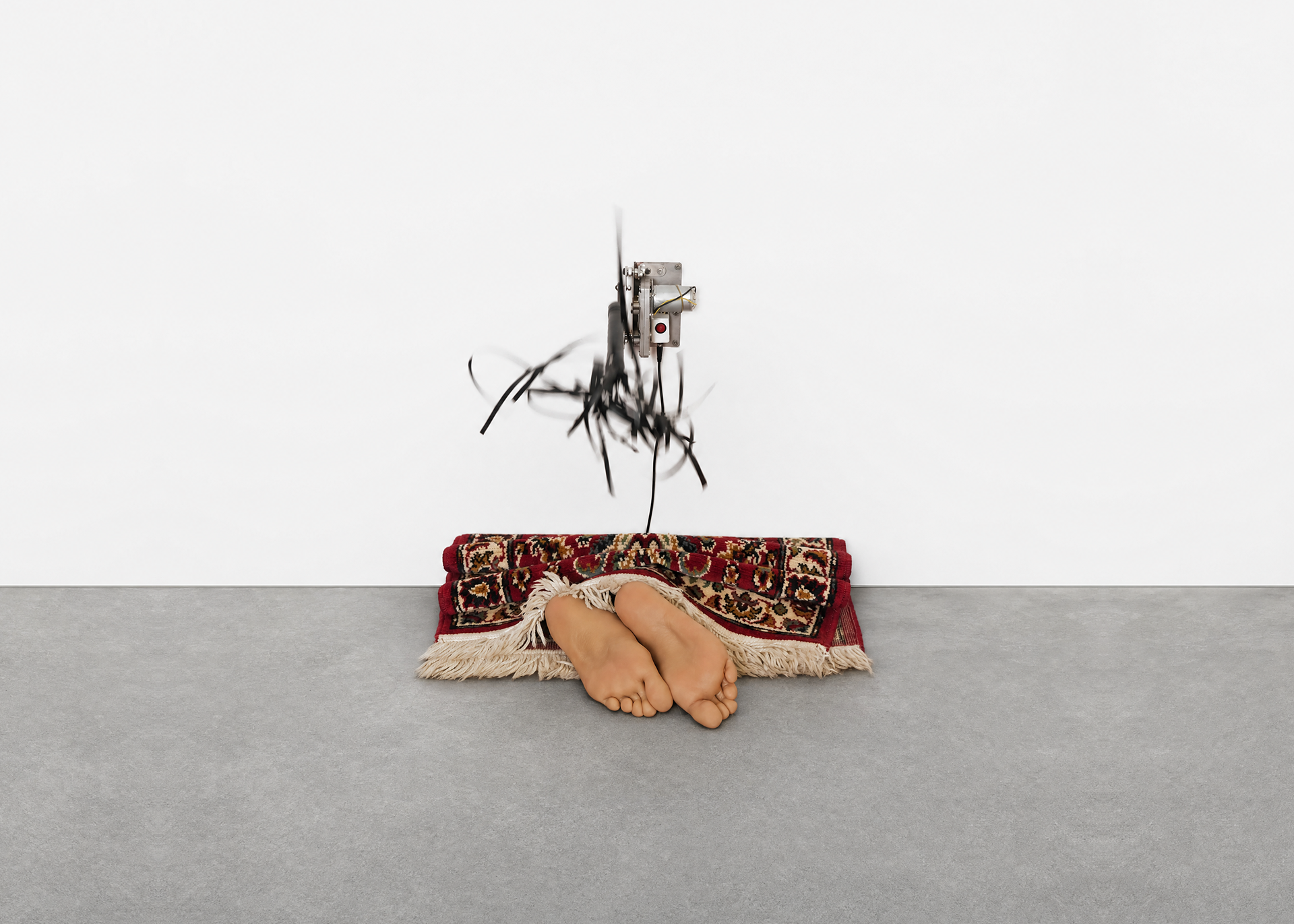
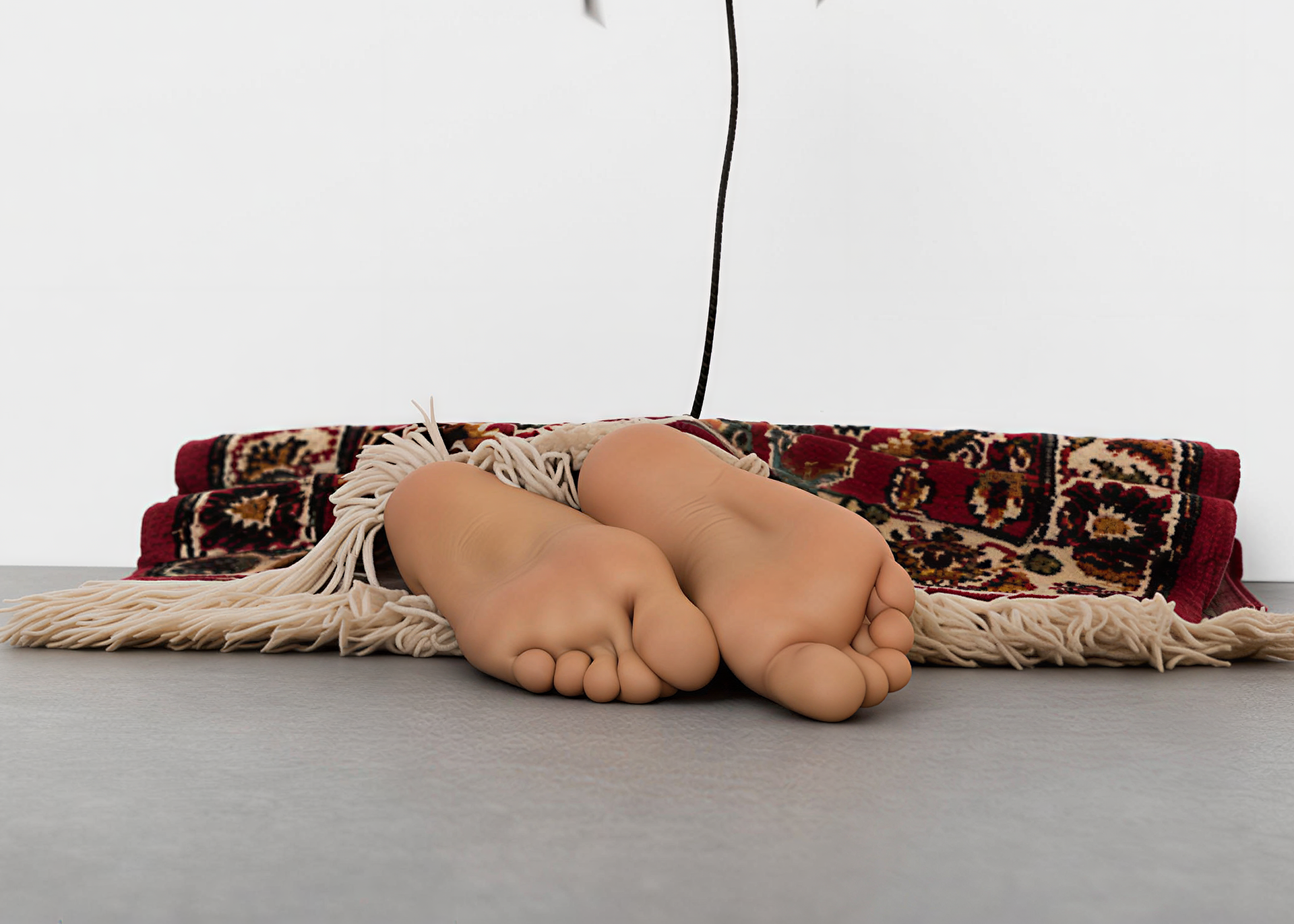
You waved the whip is a kinetic installation made with an electric motor, a short leather whip, a patterned carpet, and a silicone sculpture. A small motor is fixed to the wall, swinging the whip above the carpet. Beneath it, only a pair of silicone feet remains visible. The rest of the body is covered, while the machine continues to repeat the same action.
The work keeps the structure of punishment, but removes the person who performs it. There is no face, no hand, no visible authority figure. The title addresses a “you,” yet that “you” never appears. What remains is a mechanism: the motor moves, the whip falls, the feet stay exposed. Yú turns a gesture associated with punishment into a repeated routine, separating violence from intention while keeping its effect on the body intact.
The scene resembles a punishment game whose rules have already been fixed. There is a player who never appears, a machine that takes over the action, and a body already placed in the position of receiving. The feet cannot move away; the motor does not need to decide. In this sense, the work is not only about violence, but about how violence can be organized as a rule.
The exposed feet bring the work into a more private and bodily scale. They make the body appear both present and defenseless: realistic enough to suggest a person, incomplete enough to deny that person a face, voice, or reply. Their size, position, and vulnerability make the action difficult to separate from childhood punishment. The work does not show a child directly, but it suggests how early discipline can be felt through the body before it becomes a clear memory.
The carpet is also important. It shifts the work away from a public image of violence and brings it closer to the scale of a room. It is soft, familiar, and domestic, yet it covers the body and leaves only the most vulnerable part exposed. Through this ordinary material, the act of whipping begins to resemble correction, discipline, or training: something repeated until it becomes part of how a body understands order.
Yú does not present violence as a dramatic event. He reduces it to a small arrangement: a motor, a whip, a carpet, two feet, and a repeated movement. The work is strongest when it stays this plain. The motor does not need anger or intention; it only needs to continue. In this quiet setup, punishment becomes procedural, almost ordinary. The installation shows how a body can be trained to receive force when force is organized as rule, habit, or play.